
What to Talk About With Someone You Just Met Online
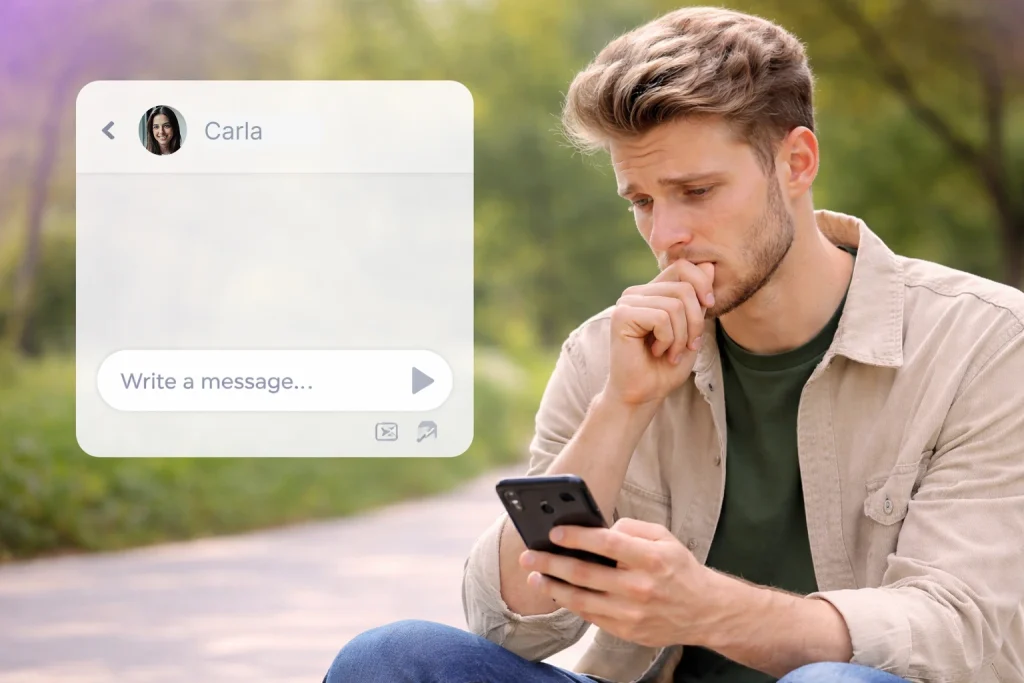
You matched. You followed back. You sent a friend request, and they accepted. Now comes the part that somehow feels harder than all of it combined — actually saying something.
Pick your favorite app — Instagram, Hinge, Bumble, TikTok, Discord — and chances are you’ve already used it to stumble into someone’s orbit. The world has never had more ways to meet people, and yet that blinking cursor in an empty text box has never felt more intimidating. Getting to know people online is the norm now. Friendships, relationships, and some of the most genuine conversations people have today all start with a stranger on the other side of a screen — and a single “hey” can spiral into a six-hour text conversation when both people know how to show up for it.
Most people don’t struggle with interest. They struggle with knowing what to say. Knowing how to start a talking stage, keep things going, and not turn it into an interrogation — that’s a real skill. This article is here to help you build it, with good conversation starters, the right questions to ask, and a full toolkit of conversation starters for texting that actually sound like a human wrote them.
Why the First Message Feels So Hard
Before diving into what to say, it helps to understand why this is hard in the first place.
When you meet someone in an in person conversation, the environment does half the work. You’re both in the same room. You have shared context, body language to read, and things around you to react to. Online, that scaffolding disappears. You’re looking at a profile — a curated, carefully assembled version of a person — and trying to build a bridge to the real human behind it. The platform you’re using shapes that experience more than most people realize — and if you’re curious how different sites handle this, the Wingtalks review on Psychreg is a good example of what to look for and watch out for.
Add to that the absence of tone. Unlike in person dates or face-to-face moments, text strips out everything nonverbal. Sarcasm can land flat. Enthusiasm can read as desperation. A perfectly reasonable question can feel abrupt. It’s no wonder most people stare at the screen for three minutes and then close the app.
But here’s what actually matters: no one is expecting you to be brilliant. They’re hoping to be heard. The first impression you make online isn’t about cleverness — it’s about showing genuine interest in who the other person actually is.
Good Conversation Starters That Open Doors

The goal of early online conversation isn’t to impress — it’s to discover. The best conversation starters do one thing well: they open doors instead of closing them. They invite stories rather than yes/no answers, and they give both of you something real to react to.
Here are good conversation starters organized by the kind of connection you’re trying to build.
Easy Conversation Starters to Break the Ice
Sometimes you just need a low-stakes entry point — something light, fun, and easy to answer. These easy conversation starters work because they signal warmth without pressure:
- “What’s been the best part of your week so far?”
- “Are you a morning person or a night owl? I feel like this tells me everything about a person.”
- “What are your plans for today — anything fun or just surviving?”
- “What’s your go-to karaoke song? Mine is embarrassing and I fully own it.”
- “Okay hot take: what’s a food opinion you hold that most people would argue with?”
These kinds of conversation starters for texting work because they’re specific, they signal personality, and — crucially — they leave room for the other person to show up as themselves. They also tend to generate a follow-up naturally, which is exactly what you want from early exchanges.
Conversation Starters for Texting That Go a Little Deeper
Once a text conversation has some warmth to it, slightly deeper conversation starters for texting start to feel natural rather than intense. These are great for moving past small talk without making things heavy:
- “What’s something you’ve gotten really into recently that you didn’t expect to love?”
- “Is there a skill you’ve always wanted to pick up but haven’t yet?”
- “What’s a favorite childhood memory that still makes you smile today?”
- “What does your ideal Saturday look like when you have absolutely nowhere to be?”
- “If you could describe yourself in three words, what would they be — and then what three words would your best friend probably use?”
- “What’s your proudest accomplishment that most people in your life don’t know about?”
- “Is there something that really lights you up that most people wouldn’t guess about you?”
Notice that each of these is open-ended. Using open-ended questions is one of the most reliable techniques for keeping a phone conversation or text thread alive, because they can’t be answered with a single word.
Fun and Playful Conversation Starters for Texting
Humor is one of the fastest ways to build rapport, and playful conversation starters for texting tend to produce the most memorable early exchanges:
- “You get a one-way time machine — where and when are you going?”
- “If your life had a theme song, what would it be?”
- “What’s your most embarrassing thing you’re willing to admit to a near-stranger?”
- “Zombie apocalypse: what’s your role in the group — leader, medic, or the one who accidentally gets everyone killed in episode two?”
- “If you could have dinner with any famous person or historical figure, who’s getting the invite?”
- “What’s your guilty pleasure TV show? I promise not to judge. (I will absolutely judge.)”
- “What would the warning label on you say?”
Good conversation starters don’t need to be deep to be effective. Funny, hypothetical, or slightly absurd questions reveal personality just as much as serious ones — and they create a tone of playfulness that makes the whole conversation feel like fun rather than work.
What Topics to Actually Talk About
Beyond individual questions, it helps to know which broader topics tend to produce the best text conversation material. Here’s what consistently works — and why.
Their everyday life and what they enjoy
Ask what they’ve been excited about lately. Ask about their favorite way to spend a weekend. Ask about their favorite meal to cook or their favorite holiday. These questions are endlessly expandable and reveal personality almost immediately. People describe themselves most honestly when they’re talking about small, specific, everyday things — not their highlight reel.
Travel and places
Few things open people up like talking about places they’ve been or dream of going. Questions about travel tap into memory and aspiration at the same time. “Is there somewhere you visited that kind of changed how you see things?” is one of the most interesting thing-revealing questions you can ask someone early on. It almost always generates a real story.
Entertainment and pop culture
Asking about a favorite movie, a TV show they’re obsessed with, reality TV guilty pleasures, their best concert, or their first concert experience — all of this is conversational gold. Pop culture is low-stakes, deeply personal, and great for finding unexpected common ground. It also makes an easy bridge to “we should watch that together sometime” when the moment feels right.
Work and what drives them
Most people ask about job titles. The more interesting version is asking what they love about what they do, what their dream job would look like, or whether they’d define success the same way now as they would have five years ago. “Is your job something you always saw yourself doing or did you kind of fall into it?” almost always produces a real story rather than a rehearsed answer.
Values, role models, and what they care about
Questions about a person’s role model, what important lesson they’ve learned recently, or what they want to be remembered for sound intense on paper but land surprisingly well in a text conversation that’s already comfortable. These are the kinds of questions that make someone think — and when someone thinks, they tend to share something genuine.
The quirky and personal
Ask about hidden talents. Ask about a secret talent they’ve never found a real use for. Ask what they’d tell their younger self, or what the best gift they ever received was. Ask about their love language or what a best compliment sounds like to them. Ask what made them smile today. These questions work because they’re unexpected — and unexpected questions cut through the noise of every other conversation happening on every other phone screen.
The IFR Method: How to Keep Any Conversation Going
One of the most useful frameworks for text conversation is the IFR Method: Inquire, Follow up, and Relate.
- Inquire — ask a genuine question
- Follow up — respond to what they actually said before moving on
- Relate — share something about yourself in return
This keeps the conversation balanced. It prevents it from becoming an interrogation on one side or a monologue on the other. Sharing something about yourself after asking a question is how reciprocal disclosure happens — and reciprocal disclosure is what actually builds trust between two people who are still figuring each other out.
Transition phrases like “that reminds me” or “funny you say that, because” are small tools that help shift between topics without the conversation feeling choppy or forced.
Deep Questions for When the Conversation Has Warmed Up
Once you’ve established some rhythm and comfort, deeper questions become welcome rather than overwhelming. These are the kinds of questions that move a text conversation from interesting to genuinely connecting:
- “What’s a favorite childhood memory you could revisit anytime?”
- “What’s the most romantic thing someone has done for you — or that you’ve done for someone else?”
- “What’s the last time something completely changed how you looked at a situation?”
- “What’s something about your personal life you think most people misread about you at first?”
- “What’s on your bucket list that you’re actually working toward — not just saying someday?”
- “What did your past year teach you that you didn’t expect to learn?”
- “How do you think your best friend would describe you — be honest?”
- “What’s an important lesson that took you longer than it should have to learn?”
- “What does your first kiss story say about who you were back then?”
- “Have you figured out your love language, or are you still working it out?”
These questions invite vulnerability without demanding it. They show that you’re interested in the whole person — not just the version they perform online.
Topics to Avoid Early On
Knowing what to talk about with someone you just met online also means knowing what to hold back. Some topics create friction before there’s enough foundation to handle it:
Avoid heavy topics in early exchanges. This isn’t about being shallow — it’s about pacing. Discussions about your last relationship, relationship status, or personal heartbreaks are better saved for phone calls or in person meetings where tone and body language can carry some of the weight.
Skip the clichés. Commenting on the weather or leading with “hey, how are you?” doesn’t advance the conversation. It signals low effort and tends to produce equally low-effort replies.
Don’t lead with personal victories or past hurts. Both can make the other person feel like an audience rather than a participant.
Be mindful of tone and emojis. What feels warm and jokey to you can read as sarcastic or passive-aggressive to someone who doesn’t know you yet. When in doubt, clarity beats cleverness.
Avoid sexually explicit statements unless that is clearly and mutually the direction of the conversation — and even then, read the room carefully.
Know when to move on. If the conversation feels stagnant across multiple exchanges and you’re the only one generating energy, it may be a sign to let it go rather than force it.
From Text to Real Life
The talking stage eventually has to evolve. At some point, a great text conversation is just the opening act — the real connection happens when you bring it into the physical world.
The signal that someone’s ready to meet is usually visible in the conversation itself: messages get longer, they ask follow-up questions without prompting, they reference things you said earlier, they start suggesting things (“we should try that place sometime”). When you see that, it’s safe to be direct. Suggest a specific plan rather than a vague “we should hang out” — it’s more confident and far easier to say yes to.
The goal of every conversation starter, every funny question, every late-night text thread, is ultimately this: to give two people a reason to want to close the distance. The good conversation starters aren’t just icebreakers — they’re the beginning of something.
Final Thought
No one gets this perfectly right every time. Conversations stall, questions land awkwardly, and sometimes two people just aren’t the right match no matter how well-crafted the opening line was. That’s fine. That’s the whole thing.
The best approach to figuring out what to talk about with someone you just met online is simply to show up with genuine curiosity — about who they are, how they think, what they love, and what keeps them up at night. Curiosity is magnetic. And unlike a perfect opening line, it’s something you can actually choose every single time.
So go ahead. Say something. The conversation is waiting.
